Global Warming: A Step by Step Look At the Key Arguments – Part 7: Is the evidence supporting global warming so overwhelming that we should no longer debate or delay.?

This is my final segment in a series discussing global warming.  In my first segment I stated that, to conclude that the United States needs to take serious measures to fight global warming, all of the following questions must have the answer of true.


  • Global temperatures are rising.
  • Carbon emissions from humans are why global temperatures are rising.
  • The global warming will cause catastrophic environmental consequences.
  • It is the proper role of the United States government to enact regulations on private companies and individuals to protect the environment.
  • The actions of the United States government will effectively prevent these consequences.
  • The evidence supporting all of the above is so overwhelming that we should no longer debate or delay.

Before I discuss these questions, however, I would like to take a moment to discuss the methodology of this series.  I relied on data from mainstream sources or sources that overtly supported global warming.  As an addendum at the end of this post, I breakdown my sources by category.  Although there were many sources for convincing arguments and data against global warming, I did not use them if I could not find solid support in an unbiased source.  My arguments are based entirely upon the same data that global warming supporters use along with the predictions made by global warming supporters.

So here is my summary of the first five questions as delineated in previous segments along with the final question to be discussed here.

Are global temperatures rising?

Global temperatures rose in the second half of the twentieth century.  They have been flat for the last fifteen or so years.  It is unclear if this means global warming has stopped or if this is just a pause.

Are carbon emissions from humans are why global temperatures are rising?

There are many factors that contribute to variations in global temperatures.  Carbon emissions from humans are one possible factor. The statement that these emissions will cause a significant temperature rise is an unproven theory supported by computer models.  So far the predictions made by these models have not been fulfilled.  While this theory has certainly not been disproved, it also has not been proved.

Will global warming cause catastrophic environmental consequences?

Although Al Gore and others have been predicting Armageddon, even most scientists who support global warming say that these claims are grossly exaggerated.  While global warming has been theorized to cause every type of climate calamity one can think of, there is a lack of evidence to support this.

Is it the proper role of the United States government to enact regulations on private companies and individuals to protect the environment?

Yes

Can the actions of the United States government will effectively prevent these consequences?

The proposed actions of The EPA to combat global warming are unlikely to have any meaningful impact and will be dwarfed the increased carbon emissions from China, India, and other developing countries.  There is a much greater chance that they will have a significant negative impact on our economy.  The one thing the government could do to significantly reduce carbon emissions, promote fracking, is opposed by environmentalists.

Is the evidence supporting all of the above is so overwhelming that we should no longer debate or delay?

As I stated at the beginning of this topic, for the answer for this to be yes, all of the above questions would require a yes. While none of these questions can definitively answered no, only one can be answered yes.  Taken as a whole, the evidence is certainly not definitive.  To state once again, extraordinary claims require extraordinary evidence.  If we are to take steps that will have significant and possibly devastating consequences to the economy and our lifestyles, we need much more evidence than we have right now.

The debate certainly is not over, despite President Obama’s statement to the contrary.  A true scientist encourages debate and doesn’t try to end it.  Einstein never said the debate is over on relativity.  We should not say this debate is over now.

Addendum

Going back through the last six segments, I would break down my references into the following categories:

Government/Academia:

Intergovernmental Panel on Climate Change (IPCC), NASA, Princeton, The Federal Register

Mainstream Journalism:

Washington Post, ABC News,, Baltimore Sun, Forbes, Wall Street Journal, USA Today, Scientific American, The Economist, The Guardian

Internet Sites (Supposedly Neutral):

Wikipedia, ScienceLine.Org,  TheHill.Com, Patheos.Com

Overtly Left Leaning Sites:

Huffington Post, Union of Concerned Scientists, Grid-Arendal, Yale Climate Connection

Overtly Right Leaning Sites:

CNS News, Investors Business Daily (editorial), National Review

Advocates of global warming could argue that the right leaning sites are invalid.    I used the Investors Business Daily editorial as an example of a claim by opponents of global warming that I stated I could not verify. I used CNS news for a quote from John Kerry that was widely reported in right leaning sites and ignored elsewhere. The National Review was used to cite comments inside of EPA regulations that was not reported in mainstream sites. I will leave it to the reader as to the affect this has on my arguments.


All Global Warming Posts
Global Warming: A Step by Step Look At the Key Arguments – Part 1

Global Warming: A Step by Step Look At the Key Arguments – Part 2: Are global temperatures rising?

Global Warming: A Step by Step Look At the Key Arguments – Part 3: Do carbon emissions from humans cause global temperatures to rise?

Global Warming: A Step by Step Look At the Key Arguments – Part 4: Will global warming will cause catastrophic environmental consequences?

Global Warming: A Step by Step Look At the Key Arguments – Part 5: Is it the proper role of the United States government to enact regulations on private companies and individuals to protect the environment?

Global Warming: A Step by Step Look At the Key Arguments – Part 6: Can the actions of the United States government effectively prevent these consequences?

Global Warming: A Step by Step Look At the Key Arguments – Part 7: Is the evidence supporting global warming so overwhelming that we should no longer debate or delay?

Global Warming: A Step by Step Look At the Key Arguments – Part 6: Can the actions of the United States government effectively prevent these consequences?

In the last four sections I discussed whether global warming/climate change is a real problem with serious consequences.  I believe I have shown that the answer to this is most likely no.  For this section, though, we will assume that I am totally wrong and that this is a serious problem with potentially devastating consequences.  I also showed that, if this is a serious problem, the United States government does have the responsibility to act. The next question is whether actions by the United States government would be effective in reducing global warming.

In June 2014, the EPA issued new regulations to combat global warming.   A key provision of these regulations is that the electricity sector must cut carbon emissions by 30% from 2005 levels by 2030.  The U.S. Chamber of Commerce estimates that  by 2030 these regulations will cause consumers to  pay $289 billion for electricity, cost 224,000 jobs, and lower household disposable incomes by $586 billion.  The EPA disputes these numbers.  It says that the regulations will create new green jobs.  It also states that the costs of climate change would be much greater.

The Obama administration also stated that the stimulus would create green jobs.  This didn’t happen.  The statement that the costs of climate change would exceed the costs to the economy of the regulations assumes that the regulations would have a significant impact on global warming.  If there is no impact, there are no cost savings due to the impact.

What impact does the EPA say these regulations will have on global temperatures?  Actually, the EPA does not say anything in its regulations to predict the impact.  Opponents state that the impact would be approximately .03 degrees by 2100, but I have not been able to locate an impartial source to back this claim.  On the other hand,  I also have not found anything by the EPA to suggest that the impact would be greater.  In September 2013 on page 346 of a  463 page report the EPA stated “The EPA does not anticipate that this proposed rule will result in notable CO2 emission changes.”  Also in September in 2013 EPA administrator Gina McCarthy stated in hearings before the House Energy and Commerce Committee that the EPA could not measure if its policies are decelerating global warming or if they have any affect at all.  In short, if the EPA has any idea of how its regulations will affect global warming, it is not publishing this data.

The main reason that the United States cutting back on greenhouse gasses would be ineffectual, however, is that reductions in carbon emissions in the United States will be dwarfed by increased emissions from developing countries, most notably China and India.  In 2007 the United States emitted more carbon dioxide than any other country.  Now China is the top emitter with 25% of global emissions and the United States now emits 17%.  In 2012 the Scientific American reported that by 2015 China would emit 49% more carbon dioxide than the United States.  This trend is expected to escalate.

ChinaUSACarbonEmissions

Carbon emissions in the United States have actually been decreasing.  This chart shows actual United States carbon emissions from 1990 to 2012:


This decrease can primarily be attributed to fracking, which has greatly decreased the cost of natural gas resulting in many areas switching from coal to natural gas to produce electricity.  In 1997, half of the electricity in the United States was generated from coal.  By 2012 this decreased to 36.7%.    Due to fracking the United States may reach President Obama’s 2009 environmental goal to reduce emissions by 17% from 2005 levels by 2020.

Since the environmental movement continually states that global warming/climate change is the greatest threat to the earth, one would think that the environmentalists would be embracing fracking.  Instead, the environmentalists are fighting to ban fracking.  They state that chemicals from fracking can seep up through thousands of feet of rock to contaminate drinking water, despite a lack of evidence that this happened or could happen.  A report from MIT found that only a handful of 20,000 wells drilled in the last decade caused any contamination, and when this occurred it was primarily due to surface spills.

In summary, there is no evidence that the current regulations proposed by the United States government would do anything to impact global warming/climate change.  With growth in carbon emissions in the developing world, any potential impact of these regulations would be dwarfed by increased emissions elsewhere.  With this in mind, is it worth the potentially heavy costs of these regulations?  The one thing that the government can do to reduce carbon emissions is to remove burdensome regulations restricting fracking, keeping only those regulations truly needed for it to be done safely.  That of course is the one thing our government won’t do.


All Global Warming Posts
Global Warming: A Step by Step Look At the Key Arguments – Part 1

Global Warming: A Step by Step Look At the Key Arguments – Part 2: Are global temperatures rising?

Global Warming: A Step by Step Look At the Key Arguments – Part 3: Do carbon emissions from humans cause global temperatures to rise?

Global Warming: A Step by Step Look At the Key Arguments – Part 4: Will global warming will cause catastrophic environmental consequences?

Global Warming: A Step by Step Look At the Key Arguments – Part 5: Is it the proper role of the United States government to enact regulations on private companies and individuals to protect the environment?

Global Warming: A Step by Step Look At the Key Arguments – Part 6: Can the actions of the United States government effectively prevent these consequences?

Global Warming: A Step by Step Look At the Key Arguments – Part 7: Is the evidence supporting global warming so overwhelming that we should no longer debate or delay?
Sources

https://www.federalregister.gov/articles/2014/06/18/2014-13726/carbon-pollution-emission-guidelines-for-existing-stationary-sources-electric-utility-generating

http://news.investors.com/ibd-editorials-on-the-right/073014-711064-epa-junk-science-costs-jobs-hurts-livelihoods.htm?ntt=epa%20regulations%20global%20warming

http://online.wsj.com/articles/energy-regulators-say-epas-climate-rule-poses-grid-challenges-1406659902

http://www.nationalreview.com/corner/359640/epa-admits-new-power-plant-regs-wont-affect-climate-change-alec-torres

http://www.nationalreview.com/corner/359067/epa-head-admits-epa-cant-measure-effects-regs-announces-more-new-power-plants-sterling

http://www.usatoday.com/story/news/2014/04/11/united-nations-climate-change-carbon-emissions/7593019/

Global CO2 emissions: Increases dwarf recent U.S. reductions

http://en.wikipedia.org/wiki/Greenhouse_gas

http://www.scientificamerican.com/article/china-greenhouse-gas-emissions-rise-past-us/

http://www.economist.com/blogs/schumpeter/2012/05/americas-falling-carbon-dioxide-emissions

http://www.forbes.com/sites/energysource/2012/12/07/surprise-side-effect-of-shale-gas-boom-a-plunge-in-u-s-greenhouse-gas-emissions/

http://www.economist.com/blogs/economist-explains/2013/08/economist-explains-13

Global Warming: A Step by Step Look At the Key Arguments – Part 4: Will global warming will cause catastrophic environmental consequences?

In the last two sections I demonstrated that whether global temperatures are rising, and if they are rising, is the cause man-made is far from certain. For this section, let us assume that they are true. Specifically, let us assume that global temperatures are rising due to excess greenhouse gasses emitted by human activity. The next question is what would be the results of this warming. In particular, would the results be catastrophic?

There have basically been two Armageddon scenarios proposed by global warming scientists. The first scenario is that the polar ice caps will melt resulting in higher sea levels which will put our coasts under water. Hollywood took this scenario to its extreme in the 1995 movie “Waterworld” where the seas rise so high that virtually the entire world is under water. The second scenario is climate change. Scientists have predicted that greenhouse gasses will increase virtually every nasty weather pattern imaginable including hurricanes, tornadoes, floods, droughts, and even freezing temperatures. Once again Hollywood has made a movie about this devastating climate change in the 2004 film “The Day After Tomorrow”

First, let us look at rising sea levels.  In Al Gore’s “An Inconvenient Truth” Gore predicted that sea levels would rise twenty feet causing coastal cities to sink beneath the sea leaving millions of people homeless.  He states this can happen in the “near future”.  Here is a short clip of what he predicts will happen:

 In 2007, the International Planet on Climate Change (IPCC), which is a strong supporter of global warming theory, predicted that sea levels would rise .59 to 2.0 feet over the next one hundred years.   There is no scientific evidence to support Gore’s inflated claims.  There is also strong reason to doubt even these predictions as other IPCC predictions have not come true, but assuming that this prediction is accurate, what would be the effect?  

For comparison, sea levels between 1870 and 2004 rose a total of 7.7 inches.   So far, the world has survived this without devastation.  Undoubtedly some very low-level coastal communities would experience flooding.  Even if we could prevent this by reducing our greenhouse gas emissions to early 1800’s levels as President Obama has proposed, would it be worth it?  

The second scenario is climate change.  Whenever there is a natural disaster we hear it blamed on climate change due to global warming.  They blamed Hurricane Katrina on climate change.  Just last month California governor Jerry Brown blamed California’s drought on climate change.  I’ve even seen people blame sun spots on global warming.  A British-based science watchdog, Number Watch, documented a list of 756 conditions that have been blamed on Global warming: http://www.numberwatch.co.uk/warmlist.htm.  I clicked randomly on a link from the list for flesh-eating disease and got this:  http://www.sciencedaily.com/releases/2007/08/070815152912.htm

Let’s take a look at one of the most popular claims, that global warming causes an increase in hurricanes.  According to Time Magazine, an intense hurricane (Category 3 or greater) hasn’t hit land in the United States since Wilma in 2005.  This is the longest ever recorded time between hurricanes.  In 2007 IPCC said there was more than a 50% certainty that human activity was contributing to increased hurricane activity.  Now the IPCC has low confidence, 20%, that there is a relationship.

This of course won’t stop the next hurricane, and of course there will be a next hurricane, from being blamed on global warming.  If the weather is hotter, it proves global warming.  If the weather is colder, it proves global warming.   If there is too much rain, it proves global warming.  If there is too little rain, it proves global warming.  What doesn’t prove global warming?

Karl Popper is known as one of the greatest scientific philosophers of the twentieth century.  H promoted the concept of falsiability.  For something to be considered science, you have to be able to disprove it.  Falsiability has been the leading argument against teaching “creation science” in schools by saying it isn’t a science.

A scientific hypothesis must be testable and falsifiable. That is to say, a hypothesis must make predictions that can be compared to the real world and determined to be either true or false, and there must be some imaginable evidence that could disprove it. If an idea makes no predictions, makes predictions that cannot be unambiguously interpreted as either success or failure, or makes predictions that cannot be checked out even in principle, then it is not science.

Various forms of creationism fail on all three counts here. For example, “intelligent design” creationism makes no testable predictions at all – it makes no checkable claims about how to identify design, who the designer is, what the designer’s goals and motives are, what the mechanism of design is, or when and where the design takes place. In fact, it makes no positive claims whatsoever, other than the hopelessly vague assertion that some intelligent being played a role in the diversification of life. Unless additional details are provided – and advocates of ID have so far steadfastly refused to provide them – ID is untestable and unfalsifiable, and can thus be firmly excluded from the domain of science.

Other forms of creationism, such as the young-earth creationism derived from a literal reading of the Bible, do make some testable claims. However, when these claims do not pan out, YEC advocates typically seek to rescue them from falsification by adding additional qualifications that make them untestable. For example, when radiometric and other dating methods show the Earth to be older than the 6,000 years YEC predicts, advocates of this idea often respond by saying that the world was created with an “appearance of age” – that it came complete with false evidence of a history that never happened. No conceivable evidence could prove this idea wrong even in principle, making any version of creationism that relies on it unambiguously not science.


-www.patheos.com

Personally, I think this argument against creation science is quite valid.  I would apply the same arguments to each of the 756 calamities blamed on global warming and to global warming itself.  What could disprove global warming?  Nothing can.  No matter what the result, it is attributed to global warming.  As stated in a previous segment in this series, when Einstein put forth his Theory of Relativity he made a series of predictions and stated that if these predictions could be validated it would support his theory and if they were not validated, it would disprove his theory.  When observations made during the Antarctic eclipse were in line with Einstein’s predictions, the world accepted his theory as being correct.

Without this key concept of falsifiability, how can everyone say that this is true science unless they are driven by political motives?

So getting back to this key question, will global warming will cause catastrophic environmental consequences?  In regards to sea levels rising, there might be an effect but the effect is infinitesimally small compared to what the doomsayers predict and highly unlikely to be catastrophic.  As to climate change, until someone comes up with a falsifiable theory, makes predictions, and then validates these predictions, I see no credence to this whatsoever.

All Global Warming Posts
Global Warming: A Step by Step Look At the Key Arguments – Part 1

Global Warming: A Step by Step Look At the Key Arguments – Part 2: Are global temperatures rising?

Global Warming: A Step by Step Look At the Key Arguments – Part 3: Do carbon emissions from humans cause global temperatures to rise?

Global Warming: A Step by Step Look At the Key Arguments – Part 4: Will global warming will cause catastrophic environmental consequences?

Global Warming: A Step by Step Look At the Key Arguments – Part 5: Is it the proper role of the United States government to enact regulations on private companies and individuals to protect the environment?

Global Warming: A Step by Step Look At the Key Arguments – Part 6: Can the actions of the United States government effectively prevent these consequences?

Global Warming: A Step by Step Look At the Key Arguments – Part 7: Is the evidence supporting global warming so overwhelming that we should no longer debate or delay?

Resources: 

Al Gore’s movie ‘An Inconvenient Truth’ says sea levels could rise up to 20 feet. Is this true?

http://en.wikipedia.org/wiki/Current_sea_level_rise

http://news.investors.com/ibd-editorials/040510-529363-a-complete-list-of-bad-things-attributed-to-global-warming.htm?ntt=fewer%20hurricanes

A Silent Hurricane Season Adds Fuel to a Debate Over Global Warming

http://en.wikipedia.org/wiki/Karl_Popper

https://www.princeton.edu/~achaney/tmve/wiki100k/docs/Falsifiability.html

Why Creationism Isn’t Science


Global Warming: A Step by Step Look At the Key Arguments – Part 2: Are global temperatures rising?

New computer modeling suggests the Arctic Ocean may be nearly ice-free in the summertime as early as 2014″.

– Al Gore at the Climate Change Conference in Copenhagen in 2009

“What we are seeing around the world is what scientists have predicted.  They’re not telling us that we may see global climate change. We are seeing it, and we’re seeing the impacts now.”

-John Kerry in Mexico City, May 21, 2014


In the first part of this series, I delineated six statements which must all be true for the United States to justify taking severe action to combat global warming:

  • Global temperatures are rising.
  • Carbon emissions from humans are why global temperatures are rising.
  • The global warming will cause catastrophic environmental consequences.
  • It is the proper role of the United States government to enact regulations on private companies and individuals to protect the environment.
  • The actions of the United States government will effectively prevent these consequences.
  • The evidence supporting all of the above is so overwhelming that we should no longer debate or delay.

Today we will look at the first statement:  Global temperatures are rising.

In 2003 the Union of Concerned Scientists put out the following temperature projections graph:

Image


This graph shows slowly rising temperatures in the early 2000’s which will then accelerate in the mid part of the decade.

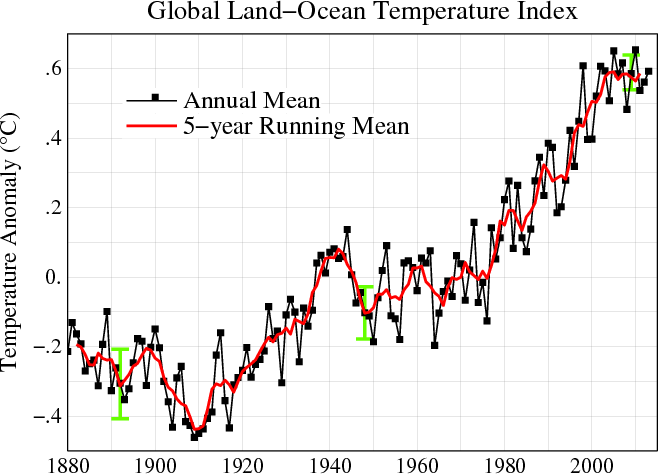
Here is a graph from NASA showing global temperature changes since 1880:


Image

This graph from NASA shows data since 1996.

Image


These graphs shows that global temperatures rose steadily from approximately 1960 till shortly before 2000.  Since then, global temperatures have been flat.  ABC News reported in September 2013, “The average global temperature hasn’t risen in 15 years, a deviation from climatologists computer-simulated predictions.”   Global warming theory backers state that fifteen years isn’t long enough to judge the trend, that it needs to be at least thirty years.  Scientists also theorize that the oceans are absorbing more heat which is causing the land-based temperature readings to not reflect the full story.  This may or may not be true.  It is just a theory.  The big point is that this was reflected in the predictions.   ABC went on to say:

The researchers’ problem: Their climate models should have been able to predict the sudden flattening in the temperature curve. Offering explanations after the fact for why temperatures haven’t increased in so long only serves to raise doubts as to how reliable the forecasts really are.

The key point here isn’t to argue whether or not the last fifteen years of flat temperature disproves the global warming hypothesis or can be accommodated by this hypothesis.  I certainly don’t have the expertise to pass any judgment here.  What I can say is that the predictions were wrong and we are being told we must take significant action based upon predictions .When Gore made his ice-free Arctic prediction as early as 2014, he did use the word “may” and did not definitively predict this lack of ice would be complete by 2014, if there was any validity to his claim, then there should have been some significant progress toward arctic balminess by now.  There has been none.

When Einstein proposed his theory of relativity, he said that if his theory was correct, then certain predictions that could be observed only during an eclipse would prove valid.  If the observations did not match his predictions, then his theory was invalid.  Years later researchers mounted an expedition to Antarctica to observe an eclipse there.  The observations matched Einstein’s predictions.   When global warming predictions don’t match the observed facts, why do so many scientists choose to ignore or excuse this?

Are global temperatures rising?

I don’t think we really have any idea.

 All Global Warming Posts
Global Warming: A Step by Step Look At the Key Arguments – Part 1

Global Warming: A Step by Step Look At the Key Arguments – Part 2: Are global temperatures rising?

Global Warming: A Step by Step Look At the Key Arguments – Part 3: Do carbon emissions from humans cause global temperatures to rise?

Global Warming: A Step by Step Look At the Key Arguments – Part 4: Will global warming will cause catastrophic environmental consequences?

Global Warming: A Step by Step Look At the Key Arguments – Part 5: Is it the proper role of the United States government to enact regulations on private companies and individuals to protect the environment?

Global Warming: A Step by Step Look At the Key Arguments – Part 6: Can the actions of the United States government effectively prevent these consequences?

Global Warming: A Step by Step Look At the Key Arguments – Part 7: Is the evidence supporting global warming so overwhelming that we should no longer debate or delay?

Resources:

http://www.cnsnews.com/news/article/patrick-goodenough/kerry-says-wrongly-some-temps-week-broke-every-record-s-ever-been

http://www.huffingtonpost.com/2009/12/14/gore-polar-ice-may-vanish_n_391632.html

http://www.ucsusa.org/global_warming/science_and_impacts/science/projections-of-climate-change.html

http://data.giss.nasa.gov/gistemp/graphs_v3/

http://abcnews.go.com/International/warming-plateau-climatologists-face-inconvenient-truth/story?id=20375601


Global Warming: A Step by Step Look At the Key Arguments – Part 1

First, all major economies must put forward decisive national actions that will reduce their emissions, and begin to turn the corner on climate change. I’m pleased that many of us have already done so, and I’m confident that America will fulfill the commitments that we have made: cutting our emissions in the range of 17 percent by 2020, and by more than 80 percent by 2050 in line with final legislation.

-Barack Obama at Copenhagen Climate Conference in 2009

Barack Obama, understanding the histrionics required in climate-change debates, promises that U.S. emissions in 2050 will be 83 percent below 2005 levels. If so, 2050 emissions will equal those in 1910, when there were 92 million Americans. But there will be 420 million Americans in 2050, so Obama’s promise means that per capita emissions then will be about what they were in 1875. That. Will. Not. Happen.

-George Will commenting on Obama’s Copenhagen pledge

Extraordinary claims require extraordinary evidence.

-Carl Sagan in Cosmos, dervied from earlier statements by Marcello Truzzi and David Hume

At the Climage Change Conference in Copenhagen in 2009, Barack Obama pledged the United States to drastically reduce carbon emissions.  Obama is the most prominent of those who say that unless we take drastic action, we will suffer devastating climactic changes including rising seas and dramatically increased hurricanes, tornadoes and other natural disasters.  While it is theoretically possible that we could make these reductions solely based upon improvements in renewable energy technologies such as solar and wind, at the current time there is no reason to believe that these technologies will progress anywhere close to the point that these advances alone will allow us to make these reductions.  This would then require Americans to dramatically reduce energy use which would severely curtail both the economy and our lifestyles.

If the climactic devastation consequences are real, then we all need to make these sacrifices, but I agree with Carl Sagan’s statement that extraordinary claims require extraordinary evidence.  Barack Obama and others claim that the debate is over, that we have all the evidence we need.  Are they right?   Is the debate truly over?

The argument by those convinced that global warming will lead to climactic devastation can be broken down into the following statements:

  • Global temperatures are rising.
  • Carbon emissions from humans are why global temperatures are rising.
  • The global warming will cause catastrophic environmental consequences.
  • It is the proper role of the United States government to enact regulations on private companies and individuals to protect the environment.
  • The actions of the United States government will effectively prevent these consequences.
  • The evidence supporting all of the above is so overwhelming that we should no longer debate or delay.

For us to take the proposed drastic actions to reduce our carbon emissions, every one of these statements needs to be true.  In this series, I will look at each of these statements in turn.  I will say now that I agree with at least one of them.  I hope that breaking down the global warming issue in this manner will help clarify the issue.

All Global Warming Posts
Global Warming: A Step by Step Look At the Key Arguments – Part 1

Global Warming: A Step by Step Look At the Key Arguments – Part 2: Are global temperatures rising?

Global Warming: A Step by Step Look At the Key Arguments – Part 3: Do carbon emissions from humans cause global temperatures to rise?

Global Warming: A Step by Step Look At the Key Arguments – Part 4: Will global warming will cause catastrophic environmental consequences?

Global Warming: A Step by Step Look At the Key Arguments – Part 5: Is it the proper role of the United States government to enact regulations on private companies and individuals to protect the environment?

Global Warming: A Step by Step Look At the Key Arguments – Part 6: Can the actions of the United States government effectively prevent these consequences?

Global Warming: A Step by Step Look At the Key Arguments – Part 7: Is the evidence supporting global warming so overwhelming that we should no longer debate or delay?

References

http://en.wikipedia.org/wiki/Carl_Sagan

http://www.theguardian.com/environment/2009/dec/18/obama-speech-copenhagen-climate-summit

http://www.washingtonpost.com/wp-dyn/content/article/2009/12/04/AR2009120403073.html